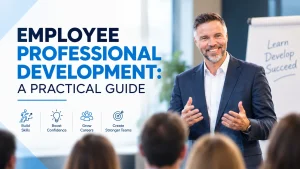
Employee professional development helps people improve their skills, communicate more effectively, and prepare for new responsibilities. But development involves more than sending employees to training sessions. People also need clear expectations, useful feedback, opportunities to practise, and managers who support their progress.
When employees do not receive enough guidance, they may struggle to improve even when they are motivated to learn. Managers can help by understanding each person’s strengths, identifying skill gaps, and creating opportunities for growth.
A practical approach to employee professional development benefits both employees and organizations. Employees become better prepared for their roles, while businesses can build stronger teams, improve communication, and prepare people for future responsibilities.
The key is to make development part of everyday work, not something that happens only during an annual review.
What Is Employee Professional Development?
Employee professional development is the ongoing process of helping people improve the knowledge, skills, and behaviours they need to succeed at work.
It can include technical training, communication workshops, coaching, mentoring, leadership training, and opportunities to take on new responsibilities. The right approach depends on the employee’s role, current abilities, and future goals.
For example, a customer service employee may understand a company’s products well but struggle with difficult customer conversations. A development plan could include practising active listening, learning how to manage complaints, and receiving feedback after customer interactions.
Over time, the employee can become more confident and handle challenging situations with less supervision.
Professional development vs. training vs. career development
These terms are related, but they serve slightly different purposes.
- Professional development: The broader process of improving knowledge, skills, and workplace behaviours over time.
- Employee training: Focused learning that helps someone perform a specific task or use a particular tool or process.
- Career development: Preparing for future roles, greater responsibility, or a different career direction.
For example, an employee might complete presentation training, practise presenting in team meetings, and eventually work toward a role that involves managing client relationships. Training supports professional development, which can contribute to career growth.
Why Is Employee Professional Development Important?
Professional development helps employees understand what they need to improve and gives them a practical way to make progress. Its value extends beyond individual performance.
1. Improves job performance
Employees who receive relevant training and regular feedback can identify mistakes, improve their working methods, and complete tasks more effectively.
For example, teaching a sales employee how to ask better discovery questions may help them understand customer needs before recommending a product.
The important point is to connect learning with an actual work requirement. Training that has no clear connection to the employee’s responsibilities may have little practical value.
2. Strengthens communication and teamwork
Technical knowledge alone does not guarantee effective teamwork. Employees must also explain ideas clearly, listen to colleagues, manage disagreements, and understand expectations.
Communication development can help people share information more accurately and reduce misunderstandings between departments.
Managers play an important role here. When they explain goals clearly and encourage honest conversations, employees have a better chance of understanding what is expected of them.
3. Builds confidence and independence
Employees often become more independent when they have the knowledge and practice needed to handle common challenges.
Instead of waiting for a manager to solve every problem, they can assess the situation, consider possible solutions, and make appropriate decisions.
Managers can support this progress by gradually giving employees more responsibility while remaining available for guidance.
4. Supports employee engagement and retention
Employees may be more willing to stay with an organization when they can see opportunities to learn, improve, and progress.
Development conversations also give managers a chance to understand what employees want from their careers. Some may want to become team leaders, while others may prefer to deepen their technical knowledge.
However, training alone does not guarantee retention. Fair treatment, reasonable workloads, good management, and suitable career opportunities also matter.
5. Prepares employees for change and leadership
Business needs change as organizations introduce new tools, processes, services, and responsibilities. Continuous learning helps employees prepare for these changes.
Professional development can also help identify future leaders. Employees who demonstrate good judgment, communication, accountability, and an ability to support others may be ready for further leadership training.
The goal is not to promote everyone into management. It is to help people develop the skills they need for the next stage of their chosen career.
The Importance of Training and Development in the Workplace
The importance of training and development in the workplace becomes clear when organizations connect learning with real performance needs.
Effective employee training programs help people do their current jobs well while preparing them for future challenges. Learning and development should support individual, team, and organizational performance, with learning needs and outcomes evaluated as part of the process.
Organizations can focus on several areas.
- Job-specific skills: Help employees understand the tasks, standards, and processes required for their roles.
- Communication and interpersonal skills: Develop listening, presentation, feedback, and conflict-resolution skills.
- Problem-solving and decision-making: Help employees assess situations and choose suitable responses.
- Leadership and management: Prepare managers to set expectations, coach employees, delegate work, and handle difficult conversations.
- Digital skills: Teach employees how to use the software, systems, and tools required for their jobs.
- Practical application: Give employees opportunities to use their new skills in real workplace situations.
A useful training program does not end when a workshop finishes. Employees need time to practise what they have learned, feedback on their performance, and support when they encounter difficulties.
For instance, after communication training, a manager might ask an employee to lead a short team meeting. The manager can then discuss what went well, identify one area for improvement, and agree on what the employee should practise next.
This makes learning part of the working day.
Effective Ways to Support Employee Professional Development
Organizations do not always need expensive training programs to help employees improve. Consistent management, relevant learning opportunities, and practical experience can make development more useful.
Create individual employee development plans
An employee development plan identifies the skills a person wants or needs to improve, the actions they will take, and how progress will be reviewed.
A good plan should reflect the employee’s current responsibilities and interests rather than follow the same template for everyone without considering their needs.
For example, a marketing employee may want to improve reporting skills, while a team supervisor may need help with delegation and feedback.
A simple plan might look like this:
| Development goal | Action | Timeline | Measure of progress |
| Improve presentation skills | Practise and deliver team presentations | 8 weeks | Clearer structure and feedback from colleagues |
| Strengthen communication | Practise active listening and summarizing discussions | 6 weeks | Fewer misunderstandings during team projects |
| Develop leadership skills | Lead a small project with manager support | 3 months | Clear delegation and timely project completion |
The plan should remain flexible. If the employee’s priorities change, the manager and employee can update the goals together.
Provide regular feedback and coaching
Feedback helps employees understand how their behaviour affects their work and other people. Coaching helps them explore challenges, consider alternatives, and decide what to do next.
Useful feedback is specific and respectful. Rather than saying, “You need to communicate better,” a manager could explain, “In yesterday’s meeting, the project deadline was not clear. Next time, please confirm the deadline and ask the team to repeat the agreed actions.”
This gives the employee something concrete to improve.
Coaching also requires listening. Managers should ask questions, understand the employee’s perspective, and agree on practical next steps instead of assuming they already know the problem.
Regular, short conversations can make this process easier than waiting for a formal annual performance review.
Offer relevant training and learning opportunities
Training can take several forms:
- Short online courses.
- Practical workshops.
- Job-specific instruction.
- Professional qualifications.
- Internal knowledge-sharing sessions.
- Guided practice with experienced colleagues.
Choose the method according to the skill gap. An employee learning a new software system may benefit from a practical demonstration, while someone preparing to manage a team may need coaching, role-playing, and supervised leadership experience.
Before arranging training, ask what the employee needs to do differently afterward. This helps connect the learning activity with a clear workplace outcome.
Encourage mentoring and knowledge sharing
Mentoring allows an experienced colleague to share knowledge, explain workplace challenges, and help another employee think through decisions.
It can be particularly useful for new employees, people changing roles, or staff preparing for greater responsibility.
For example, an experienced project manager could mentor a junior colleague by explaining how to manage client expectations, identify risks, and communicate delays.
Knowledge sharing can also happen in team meetings. Employees can discuss lessons learned from completed projects, demonstrate useful tools, and explain how they solved common problems.
The purpose is to make useful knowledge accessible rather than leave it with only one person.
Develop communication and leadership skills
Communication is a practical professional skill. Employees need it when presenting ideas, explaining problems, receiving feedback, or working through disagreements.
Leadership skills are also valuable beyond formal management roles. Employees who can take responsibility, support colleagues, and communicate clearly often contribute to stronger teams.
Development activities can include:
- Practising active listening.
- Learning how to give and receive constructive feedback.
- Explaining expectations and responsibilities clearly.
- Handling difficult conversations respectfully.
- Managing disagreements without making them personal.
- Leading meetings and presenting ideas.
These skills improve through practice, reflection, and feedback. A workshop may introduce a technique, but employees need opportunities to use it in real conversations.
Antoni Lacinai’s leadership communication programs focus on clarity, trust, feedback, engagement, and turning communication into workplace action. These themes are particularly relevant when professional development needs to improve how people work together, not just what they know.
Give employees opportunities to apply new skills
Learning is more useful when employees can put it into practice.
Managers can offer stretch assignments, cross-functional projects, job shadowing, or additional responsibilities that match an employee’s readiness.
For example, an employee who has completed project management training could coordinate a small internal project before taking responsibility for a larger one.
The manager should explain the expected outcome, provide appropriate support, and review the experience afterward.
This approach allows employees to build confidence gradually while giving the organization a clearer view of their progress.
What Does a Leadership Development Manager Do?
A leadership development manager helps an organization prepare current and future leaders to manage people, communicate effectively, and support business goals.
The exact responsibilities depend on the organization. In a large company, this may be a dedicated role. In a smaller business, HR staff, senior leaders, or department managers may share the work.
Common responsibilities include:
- Identifying leadership skill gaps and development needs.
- Planning or coordinating management training.
- Supporting coaching and mentoring programs.
- Developing communication and people-management skills.
- Preparing employees for future leadership positions.
- Gathering feedback and evaluating development activities.
- Connecting leadership development with business priorities.
A leadership development manager might identify that new supervisors understand their technical responsibilities but struggle to give feedback or delegate work.
The manager could arrange practical training, help supervisors practise difficult conversations, and work with their line managers to review progress.
The aim is not simply to complete a training program. It is to help leaders apply what they learn when managing real people and situations.
A successful approach also requires cooperation between HR, senior leadership, and team managers. HR may coordinate the program, senior leaders may define priorities, and direct managers may provide the day-to-day feedback that helps employees improve.
How to Create an Effective Employee Development Plan
An effective employee development plan starts with an honest conversation about current performance, future goals, and the support needed to make progress.
Use the following steps to build a plan that employees and managers can follow.
Step 1: Understand current skills and responsibilities
Review the employee’s role, daily tasks, strengths, and areas where they need support. Use work examples, performance reviews, and feedback to understand their current abilities.
Avoid relying only on assumptions. An employee may perform well in one situation but need help in another.
Step 2: Identify the most important development needs
Focus on skills that will make a meaningful difference to the employee’s work or prepare them for a realistic next step.
For example, if a technically skilled employee is preparing to manage client meetings, presentation skills and clear communication may be more useful than another technical course.
Step 3: Discuss interests and career goals
Ask the employee what they want to learn, which responsibilities interest them, and what challenges they would like to handle more confidently.
The manager should explain business needs while giving the employee a chance to share their own priorities. Development works best when both sides understand the purpose.
Step 4: Set clear, measurable goals
Avoid goals such as “become a better communicator.” Instead, define an action that can be observed.
A more useful goal would be: “Lead two client meetings within the next eight weeks and use a clear agenda, agreed next steps, and a written follow-up.”
Step 5: Choose suitable learning activities
Select training, coaching, mentoring, or practical assignments that address the identified need.
A course may help introduce a new skill, while role-playing and supervised practice help employees learn how to apply it.
Step 6: Agree on timelines and support
Decide when activities will happen, who will provide support, and how much time the employee can dedicate to learning.
Development should fit within a realistic workload. Adding training without adjusting other responsibilities can leave employees overwhelmed.
Step 7: Practise the new skills at work
Give employees opportunities to apply what they have learned. Managers can observe their work, discuss challenges, and offer feedback.
This is where the development plan becomes part of everyday performance rather than a document that sits unused.
Step 8: Review progress and adjust the plan
Arrange regular check-ins to discuss progress, obstacles, and next steps. If the original approach is not working, change the activities or revise the goal.
A development plan should guide improvement, not become a rigid checklist.
Example: Developing an employee for client-facing responsibilities
Consider a technically skilled employee who needs to improve communication before taking responsibility for client meetings.
| Element | Development plan |
| Goal | Communicate project updates clearly to clients |
| Actions | Practise presentations, observe a senior colleague, and lead supervised meetings |
| Timeline | 8 to 12 weeks |
| Support | Weekly coaching and feedback after meetings |
| Success measure | Clear updates, accurate answers, and agreed next steps documented after meetings |
The manager and employee can review the plan every two weeks. They should discuss what has improved, what remains difficult, and which practice opportunities would help next.
This example shows how professional growth becomes easier to manage when the goal, actions, support, and measures are clear.
Common Employee Development Mistakes to Avoid
Even well-intentioned development programs can fail when they do not reflect employees’ actual needs.
Here are common mistakes and ways to prevent them.
- Giving everyone the same training: Employees have different responsibilities and skill gaps. Assess individual and team needs before choosing activities.
- Treating development as a one-time event: Skills need practice and reinforcement. Schedule follow-up conversations and opportunities to apply learning.
- Setting unclear goals: Define what improvement looks like and how progress will be assessed.
- Ignoring employee interests: Discuss career goals and learning preferences rather than deciding everything without employee input.
- Providing no time to practise: Adjust workloads and create opportunities to use new skills on real tasks.
- Failing to provide follow-up support: Managers should discuss progress, answer questions, and help employees overcome obstacles after training.
- Measuring attendance instead of improvement: Completing a course does not necessarily mean an employee can use the skill effectively.
- Promoting people without leadership preparation: Strong individual performance does not automatically mean someone is ready to manage others. Provide guidance on delegation, communication, feedback, and people management.
The common issue behind these mistakes is a gap between learning activities and workplace behaviour. Organizations should focus on what employees can do differently after development, not simply what activities they have completed.
How to Measure the Success of Employee Professional Development
Measuring employee professional development helps organizations understand whether their investment in learning is making a practical difference.
Start by defining what success should look like before the development activity begins. The measures should reflect the goal of the program.
Useful measures of development progress
Skill improvement: Assess whether employees can perform a task more accurately, confidently, or independently.
Work quality and performance: Compare relevant indicators before and after development, such as error rates, project completion, or the quality of customer interactions.
- Progress toward development goals: Review whether employees have completed agreed actions and demonstrated the intended skills.
- Communication and teamwork: Gather examples of clearer handovers, more effective meetings, better feedback, or fewer misunderstandings.
- Employee feedback: Ask participants whether the learning was relevant, what they found difficult, and where they need more support.
- Readiness for new responsibilities: Review whether employees can handle more complex tasks or take on additional responsibilities with appropriate supervision.
- Engagement and retention trends: Track these over time as broader indicators, while recognizing that many factors beyond training affect them.
For example, after communication training, a manager might compare an employee’s presentation against an agreed checklist, gather feedback from meeting participants, and review whether follow-up actions are clearer.
The results provide more useful information than attendance records alone.
It is also important to avoid attributing every improvement to training. If customer satisfaction rises after a communication workshop, other changes may have contributed. Compare results with a starting baseline, review them over time, and use several relevant measures where possible.
How Leaders Can Build a Culture of Continuous Learning
A culture of continuous learning develops when employees can improve their skills as part of normal work. It does not require a new course every week or a separate development project for every employee.
Leaders can build this culture through everyday behaviour.
Make time for learning
Give employees reasonable time to complete training, practise new skills, and reflect on what they have learned. Development should be planned alongside daily responsibilities, not treated as extra work with no time allocated.
Encourage questions and honest conversations
Employees should feel able to ask for help, admit when they do not understand something, and discuss the skills they want to improve.
Managers can encourage this by listening without immediately criticizing people for raising concerns.
Treat mistakes as opportunities to learn
When an employee makes a mistake, first understand what happened. If the issue is a genuine learning need, discuss how to prevent it in the future.
This does not mean ignoring serious misconduct or repeated failures to follow important procedures. It means using appropriate situations to identify improvements rather than automatically assigning blame.
Give feedback and recognize progress
Feedback should be timely, specific, and connected to behaviour. Recognition should acknowledge meaningful progress, such as handling a difficult conversation more effectively or completing a task independently for the first time.
This helps employees understand which actions are useful and worth repeating.
Lead by example
Managers should also seek feedback, learn new skills, and admit when they need to improve.
When leaders show that learning applies to everyone, professional development becomes part of how the organization works rather than a requirement imposed only on employees.
Connect communication with better results
Professional development is more effective when employees understand why their learning matters.
Antoni Lacinai’s communication approach highlights the relationship between communication, behaviour, performance, and results. Leaders can apply this thinking by explaining expectations clearly, building trust, and helping employees turn new knowledge into everyday action.
When people understand what to do, why it matters, and how their work contributes to shared goals, they have a clearer basis for taking responsibility and improving their performance.
Frequently Asked Questions
1. What is employee professional development?
Employee professional development is the ongoing process of improving the skills, knowledge, and behaviours people need to succeed at work. It includes training, coaching, mentoring, feedback, and practical learning opportunities.
2. Why is professional development important in the workplace?
It helps employees improve performance, communicate more effectively, build confidence, and prepare for new responsibilities. Organizations can also use development to address skill gaps and prepare future leaders.
3. What are examples of employee professional development?
Examples include technical training, communication workshops, mentoring, leadership programs, online courses, presentation practice, job shadowing, and taking responsibility for new projects.
4. How can managers support employee development?
Managers can discuss career goals, identify skill gaps, set clear development goals, provide useful feedback, arrange relevant learning opportunities, and give employees time to practise new skills.
5. What is the role of a leadership development manager?
A leadership development manager helps identify leadership training needs, coordinate development programs, support coaching and mentoring, and evaluate whether employees are developing the skills required to lead teams effectively.
6. How can companies measure the success of employee training?
Companies can measure changes in job-related skills, work quality, performance, confidence, and progress toward agreed goals. The best measures depend on what the training was designed to improve.
7. How often should employee development plans be reviewed?
A practical approach is to have brief monthly check-ins and a more detailed review every three months. The frequency can change depending on the employee’s goals, the length of the development activity, and the urgency of the skill gap.
Conclusion: Make Employee Development Part of Everyday Work
Employee professional development is most useful when it connects learning with real workplace needs. Employees need clear goals, relevant training, regular feedback, and opportunities to practise what they learn.
Managers also have an important responsibility. They must understand individual strengths, listen to employees, explain expectations, and provide the support people need to improve.
Organizations can begin with a simple step: choose one important skill gap, agree on a clear development goal, and create a practical plan to address it. Review the results and adjust the approach as needed.
Over time, these small actions can help employees become more capable, confident, and prepared for new responsibilities.
For organizations that want to strengthen leadership communication, Antoni Lacinai offers leadership communication training and development programs, including workshops, masterclasses, and coaching. These programs can help leaders improve clarity, build trust, and turn everyday conversations into more effective workplace behaviour.