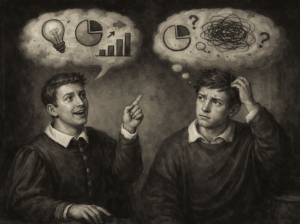
From Confusion to Clarity -who wouldn’t want that?
Ever left a meeting more confused than when you walked in? It has happened to me more times than I can count…
Ever read an email and thought, “𝘞𝘩𝘢𝘵 𝘢𝘳𝘦 𝘵𝘩𝘦𝘺 𝘢𝘤𝘵𝘶𝘢𝘭𝘭𝘺 𝘴𝘢𝘺𝘪𝘯𝘨?” (The benefit of emails is not clarity, it’s traceability – of all misunderstandings…)
Poor communication leads to misalignment, wasted time, and frustration.
I read that Grammarly asked a bunch of managers who claimed that poor communication wastes about 20% worktime. That’s a lot.
The best workplaces don’t just have the best strategies.
They have the clearest communication.
Together they generate impact.
I help leaders go from confusion to clarity, so teams know what to do and why it matters.
Want that? Let’s talk.
By Team Antoni Explains
Why “us vs them” thinking starts
Division inside teams does not appear overnight. It builds over time through small moments that go unaddressed.
A disagreement is ignored.
A conflict is left unresolved.
A lack of clarity creates assumptions.
Eventually, people stop seeing themselves as part of one team. They start identifying with smaller groups.
That is where “us vs them” begins.
The real impact on performance
At first, the impact is not obvious. Work still gets done. Meetings still happen.
But underneath, things start to change.
People communicate less openly.
Collaboration becomes selective.
Decisions are influenced by bias instead of logic.
This creates friction that slows everything down.
And over time, it a
ffects results.
When personal preference overrides team goals
One of the biggest problems in divided teams is misplaced priority.
Instead of focusing on what is right, people focus on who they agree with.
They support ideas based on relationships, not outcomes.
They avoid working with certain individuals.
They disengage when things do not suit them.
This weakens the team’s ability to act as one unit.
The role of leadership in stopping it
Leaders cannot afford to ignore early signs of division.
Because once “us vs them” becomes part of the culture, it spreads quickly.
Effective leaders:
- Step in early when tension appears
- Reinforce shared goals consistently
- Set the expectation that collaboration is not optional
They make it clear that team success comes before personal preference.
Shifting from division to alignment
Fixing this is not about forcing people to agree.
It is about creating clarity and shared direction.
When teams understand the bigger goal:
- Decisions become easier
- Collaboration improves
- Focus returns to outcomes
Alignment does not remove differences. It makes them manageable.
Final thought
Teams do not fail because of lack of talent.
They fail because they stop working together.
If people are choosing sides internally, performance will always suffer.
Strong teams move in the same direction, even when they disagree.
Because in the end, alignment is what turns individuals into a team.