Have you ever stopped to think about the impact your words have on your professional relationships, your team’s motivation, and your overall success as a leader?
Every conversation sends a message.
The way we communicate can build trust, encourage collaboration, and inspire people to perform at their best. But poor communication can create confusion, frustration, and unnecessary distance between leaders and their teams.
In today’s digital workplace, where many conversations happen through emails, online meetings, and instant messages, effective communication has become more important than ever.
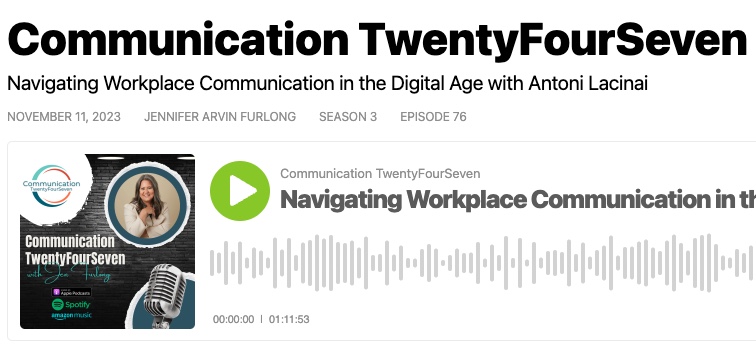
I recently had an insightful conversation about these challenges, exploring how leaders can communicate with more clarity, intention, and impact.
Why Communication Matters More Than Ever
Technology has changed the way we work.
Teams are often distributed across different locations. Many conversations happen without face-to-face interaction. Messages are shorter, faster, and sometimes easier to misunderstand.
This creates a challenge for leaders:
How do we maintain strong human connections when so much communication happens digitally?
The answer starts with understanding that communication is not only about the words we use.
It is also about:
- How well we listen
- How we make others feel
- How clearly we express expectations
- How we adapt our communication style to different people
Great leaders understand that every interaction is an opportunity to strengthen trust.
The Power of Intentional Communication
Many workplace problems are not caused by a lack of knowledge or skills. They are caused by misunderstandings.
A leader may think they have communicated clearly, while the team may have received a completely different message.
This is why intentional communication matters.
Before speaking, ask yourself:
- What is my purpose?
- What do I want the other person to understand?
- How can I communicate this in a way that creates clarity?
The goal of communication is not simply to deliver information.
The goal is to create understanding.
Listening: The Forgotten Leadership Skill
One of the key topics we explored was the importance of listening.
Many leaders believe they are good listeners because they hear what others say. But true listening goes much deeper.
There are different levels of listening.
At the lowest level, we may listen while preparing our own response. We are physically present but mentally focused on what we want to say next.
At a higher level, we listen to understand.
We become curious about the other person’s perspective, challenges, and ideas.
This type of listening creates stronger relationships and helps leaders make better decisions.
A leader who listens well sends a powerful message:
“Your thoughts and experiences matter.”
Finding the Balance Between Micromanagement and Delegation
Another important leadership challenge is finding the right balance between control and trust.
Many leaders struggle between two extremes:
Micromanagement
Micromanaging often happens when leaders feel responsible for every detail. They provide constant instructions, monitor every task, and unintentionally limit their team’s confidence.
The result can be:
- Reduced ownership
- Lower motivation
- Less creativity
Abdication
The opposite problem is leaving people completely alone without guidance or support.
Delegation does not mean disappearing.
People need clarity, resources, feedback, and encouragement to succeed.
The best leaders find the balance:
Provide direction without controlling every step.
Coaching Through Communication
Leadership today is less about having all the answers and more about helping others find solutions.
A coaching approach encourages people to think, learn, and grow.
Instead of always saying:
“Here is what you should do.”
A coaching leader asks:
- “What do you think is the best approach?”
- “What challenges are you facing?”
- “How can I support you?”
These conversations develop stronger, more confident teams.
Communication Creates Better Results
My work with leaders and organizations has shown me that communication is the foundation of performance.
When leaders communicate with clarity and empathy, teams become more engaged.
When leaders listen actively, people feel valued.
When leaders create trust, people take greater responsibility.
This is why communication is not just a soft skill. It is a business skill that directly influences results.
Final Thoughts
The digital age has changed how we communicate, but it has not changed what people need from their leaders.
People still want to feel heard.
They still want clarity.
They still want leaders who communicate with purpose and respect.
The question every leader should ask is:
“How can I make my next conversation more meaningful?”
Because better conversations create better relationships, and better relationships create better results.